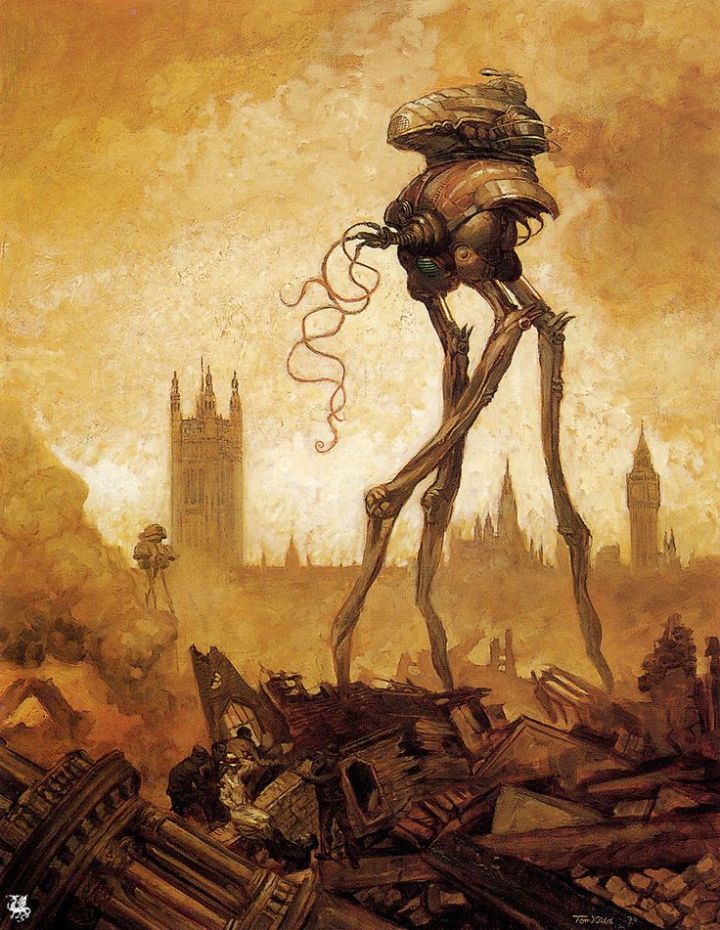
The Massacre of Mankind by Stephen Baxter
This is the sequel to H.G. Wells’ The War Of The Worlds, and is officially authorized by his estate. Anyone who has read the Wells’ classic (I haven’t) will better appreciate this story. Yet, although The Massacre of Mankind is a continuation, and I missed the beginning of the tale, I still found great enjoyment in this novel.

Julie Elphinstone is the former wife of Frank Jenkins, both central characters from the first book. She has been asked to meet with some of those who survived the initial Martian attack at the end of the 19th century. One of the survivors, Walter Jenkins, Frank’s brother, has reason to believe that the Martians are not done with the Earth and will return.
The Massacre of Mankind is set in the 1920’s, in what now must be viewed as an alternative universe. The Kaiser is in control of Europe and has made an alliance with the British as he continues to force his way further into Russia. London is still the world’s major city and, as England was the scene of the previous alien attack, it is thought that it is to England that they will return.
It can be difficult to fully engage with a story set in a time past, when we already know what happened. World events must be deliberately altered to accommodate the fictional realities (oxymoron?) that Baxter has introduced. I find that the only way I can enjoy the tale is to imagine it all taking place in an alternate existence. After all, if it’s good enough for Stephen Hawking and Stephen Baxter, then it’s good enough for me.
As Julie becomes dragged further into the dubious scheme hatched to tackle the approaching Martian menace, we are given an insight into life at that time, with some differences. England, for example, is under a dictatorship as they prepare for any future invasions. Some of the Martian technology acquired from the first wave of invaders, is now being used by humanity to assist in social progress.
India and, interestingly for me, Ireland, have both gained their independence (yahoo) at the same time, yet the King flees to Delhi at the first sign of trouble (I wonder why he didn’t choose Derry…?).
It is quite a feat for a modern author to try to write in the style of another long since passed. Yet I feel that Baxter has achieved this. He was a good choice for the Wells’ estate in that he has remained true to the approach of Wells, and the narrative and style appear to have remained consistent (I base this on other books of Wells’ that I have read).
H.G. Wells was a known socialist, as all the best people are, and in The Massacre of Mankind, Stephen Baxter makes the occasional comment that perhaps Wells would have greatly approved of. It is an example of Baxter’s commitment to detail.
Julie Elphinstone and her colleagues are taken aback, as the new wave of Martians arrive. What was thought to be a straightforward assault turns into something entirely different. Although the British are preparing to battle on their own, with some help from Imperial Germany, it becomes apparent that it is now the entire world that is in the greatest peril.

With such story-lines it is easy to see subtext and parable everywhere, especially given the attitude of H.G. Wells and, as a consequence, Stephen Baxter. One example is the very idea of a Martian attack on Earth. In The War Of The Worlds, the aliens were intent upon colonizing our planet. In that, we can draw clear parallels with the colonial intent of any number of tribes, ethnic groups and nations throughout the Earth’s history.
As the Martians are brutal and merciless, so too were the colonials of our species. Whether it was the Egyptians, Hittites, Persians, Romans, Normans, British, Spanish, Belgians, US or Israelis, we should accept that no alien species will be any worse that the worst excesses of our own, then and today. It’s a powerful concept and a sobering thought, the idea that we could all become the victims of invaders with superior technology. As Stephen Hawking pointed out, perhaps we should refrain from attempting to attract the attentions of Extra-terrestrials, as it didn’t work out too well for those people who suffered from the arrival of the more advanced on this planet.
The Massacre of Mankind is a decent size book. The story covers a lot of the planet. If you can suspend your disbelief at the concept of an alternate universe, then I believe that you will enjoy this story. I did.
I won’t give too much away, other than to say, the butler didn’t do it. Furthermore, the ending is not what I expected. I feel yet another sequel approaching. I hope the bold Tom Cruise and Steven Spielberg have nothing to do with this franchise as I didn’t enjoy their movie adaptation; it had little connection to the plot of the original novel and everything to do with maximizing profit, the true mark of capitalism. Surely H.G. Wells would be appalled.
The Massacre of Mankind is a good hearty read that would have been enjoyed immensely in the early 20th century, as it will be today. It is a modern book that lifts a somewhat outdated story-line and tries to breathe some fresh air into it. It works.
Sult scale rating: 7 out of 10. A must for fans of The War Of The Worlds.
 Rebel Voice